
Artificial intelligence (AI) is transforming how organizations innovate, optimize operations, and create competitive advantages. From intelligent automation and predictive analytics to generative AI and advanced decision-making, enterprises are increasingly relying on AI to improve efficiency and accelerate business growth.
Yet despite significant investments in AI technologies, many organizations struggle to move beyond pilot projects and achieve enterprise-scale adoption. AI initiatives often face delays, rising costs, scalability challenges, and lower-than-expected business outcomes.
The root cause is frequently not the AI itself.
Instead, the hidden barrier is technical debt.
Years of legacy applications, fragmented data environments, outdated infrastructure, and disconnected systems have left many enterprises with technology foundations that are not prepared to support AI at scale. While these systems continue to support daily operations, they often slow innovation and limit the value organizations can generate from AI investments.
As enterprises accelerate their AI transformation journeys, reducing technical debt has become a critical business priority rather than just a technology initiative.
Quick Answers: Technical Debt and Enterprise AI
Why is technical debt a barrier to AI?
Technical debt creates challenges such as data silos, integration complexity, poor data quality, infrastructure limitations, and governance gaps, all of which reduce the effectiveness of AI initiatives.
How does technical debt affect AI adoption?
Organizations often experience slower implementation timelines, higher project costs, limited scalability, and reduced AI accuracy because existing systems are not designed to support modern AI requirements.
What are the most common technical debt challenges?
The most significant challenges include:
- Disconnected data sources
- Legacy applications
- Poor data quality
- Infrastructure constraints
- Security and governance limitations
Can organizations implement AI without modernization?
Yes, but unresolved technical debt can significantly reduce the long-term value, scalability, and performance of AI initiatives.
What should organizations prioritize first?
Organizations should assess technical debt, strengthen data quality, modernize critical systems, and establish a scalable foundation that supports future AI growth.
Why Technical Debt Is Holding Back Enterprise AI
Many organizations focus on selecting AI platforms, models, and tools without first evaluating whether their technology environment is capable of supporting AI effectively.
Successful AI adoption requires:
- Connected business systems
- Trusted data
- Flexible infrastructure
- Secure environments
- Effective governance
When technical debt weakens these foundations, AI initiatives become more difficult to deploy, manage, and scale.
As a result, organizations often find themselves investing heavily in AI technologies while struggling to achieve measurable business outcomes.
The challenge is not always a lack of AI capability. The challenge is whether the enterprise foundation can support AI-driven transformation.
Four Ways Technical Debt Impacts AI Success
Data Silos Limit AI Effectiveness
AI systems depend on access to comprehensive and connected data.
However, many organizations store information across multiple platforms, including:
- CRM systems
- ERP platforms
- Customer service applications
- Supply chain systems
- Financial systems
- Operational databases
When these systems operate independently, AI models receive incomplete information.
This can lead to:
- Less accurate predictions
- Incomplete business insights
- Reduced visibility
- Lower confidence in AI-generated recommendations
Without a connected data ecosystem supported by enterprise data integration, AI cannot deliver its full potential.
Legacy Systems Slow AI Adoption
Many enterprise applications were designed before cloud computing, advanced analytics, and AI became business priorities.
These systems often lack:
- Modern APIs
- Real-time integration capabilities
- Cloud compatibility
- Flexibility for emerging technologies
As a result, organizations must often invest significant time and resources creating custom integrations before AI solutions can function effectively.
This slows deployment timelines and increases implementation complexity.
Poor Data Quality Reduces AI Accuracy
AI is only as reliable as the data it uses.
Technical debt frequently contributes to:
- Duplicate records
- Missing information
- Outdated datasets
- Inconsistent formatting
- Data integrity issues
When poor-quality data enters AI systems, the resulting insights and recommendations become less trustworthy.
Improving data quality is therefore one of the most effective ways to enhance AI performance.
Governance and Infrastructure Gaps Create Risk
Enterprise AI requires scalable infrastructure and strong governance controls.
Organizations with significant technical debt often struggle with:
- Infrastructure bottlenecks
- Security concerns
- Compliance requirements
- Access management inconsistencies
- Data governance challenges
These issues not only slow AI adoption but also increase operational and regulatory risk.
Signs Your Organization May Not Be AI-Ready
Before scaling AI initiatives, organizations should evaluate whether technical debt is creating hidden challenges.
Data Exists in Multiple Disconnected Systems
Business-critical information is spread across various applications and departments, making it difficult to establish a complete view of operations.
AI Projects Spend Excessive Time on Data Preparation
Teams spend more effort gathering, cleaning, and organizing data than developing AI capabilities.
Legacy Applications Are Difficult to Integrate
New technologies require significant customization and manual workarounds to connect with existing systems.
Performance Issues Increase as Data Volumes Grow
Infrastructure struggles to support advanced analytics, machine learning, and AI workloads.
Modernization Projects Consistently Experience Delays
Technology complexity repeatedly slows digital transformation initiatives and increases costs.
If several of these challenges exist, technical debt may already be limiting AI readiness.
Why Technical Debt Creates Challenges for Generative AI
Generative AI is quickly becoming a strategic priority for enterprises seeking to improve productivity, customer engagement, and knowledge management.
However, generative AI depends heavily on:
- Trusted enterprise information
- Accessible documentation
- Connected knowledge repositories
- Consistent governance controls
When organizational knowledge remains fragmented across legacy systems and disconnected applications, generative AI solutions struggle to deliver relevant and accurate outputs.
This can result in:
- Incomplete responses
- Irrelevant recommendations
- Reduced trust in AI-generated content
- Increased governance concerns
Organizations pursuing enterprise-scale generative AI frequently discover that modernization is a prerequisite for success.
A Real-World Example of Technical Debt Affecting AI
Consider a manufacturing organization implementing predictive maintenance.
Equipment performance data is stored within operational systems, maintenance records are kept in separate applications, and supply chain information resides in another platform.
The organization identifies an opportunity to use AI to predict equipment failures and reduce downtime.
However, before AI models can generate meaningful insights, teams must integrate systems, standardize data formats, eliminate duplicates, and address quality issues.
The AI technology itself is not the primary challenge.
The underlying technical debt is what delays deployment, increases costs, and slows business value realization.
This example reflects a common scenario across many industries.
Building an AI-Ready Foundation
Reducing technical debt requires creating a technology environment that supports long-term innovation and scalability.
Data Modernization
Data modernization helps organizations:
- Improve data accessibility
- Reduce information silos
- Enhance data quality
- Strengthen governance
- Support advanced analytics and AI
A unified data foundation enables AI systems to operate using trusted and consistent information.
Enterprise Architecture
A modern enterprise architecture provides the framework needed to connect systems, applications, and data.
Benefits include:
- Improved interoperability
- Standardized integrations
- Reduced complexity
- Greater scalability
- Faster modernization
Strong architecture ensures AI initiatives can expand beyond isolated use cases and deliver broader business value.
Governance and Security
Enterprise AI requires clear standards for:
- Data ownership
- Security controls
- Compliance management
- Risk oversight
- Responsible AI practices
Strong governance improves trust while helping organizations manage AI responsibly.
Infrastructure Modernization
Modern infrastructure provides the scalability necessary to support:
- Machine learning workloads
- Real-time analytics
- Large data volumes
- Enterprise-wide AI initiatives
Flexible infrastructure helps organizations adapt as AI requirements continue to evolve.
A Five-Step Framework for Reducing Technical Debt
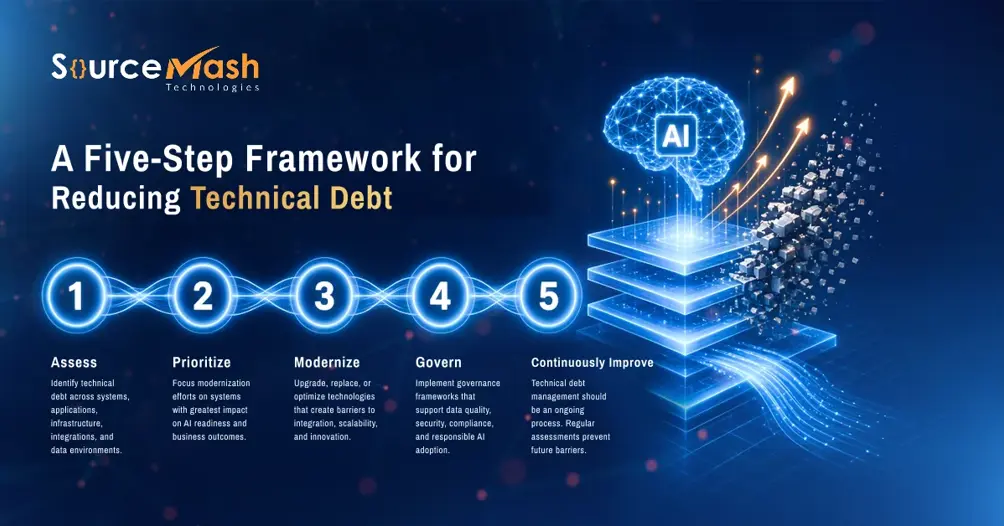
Step 1: Assess
Identify technical debt across systems, applications, infrastructure, integrations, and data environments.
Step 2: Prioritize
Focus modernization efforts on the systems that have the greatest impact on AI readiness and business outcomes.
Step 3: Modernize
Upgrade, replace, or optimize technologies that create barriers to integration, scalability, and innovation.
Step 4: Govern
Implement governance frameworks that support data quality, security, compliance, and responsible AI adoption.
Step 5: Continuously Improve
Technical debt management should be an ongoing process. Regular assessments help prevent future barriers from accumulating.
Enterprise AI Readiness Checklist
Before scaling AI across the organization, ask the following questions:
✅ Is enterprise data accessible and trusted?
✅ Are critical business systems integrated?
✅ Is data quality consistently managed?
✅ Can infrastructure support future AI workloads?
✅ Do applications support modern integration standards?
✅ Are governance and compliance frameworks established?
✅ Is technical debt regularly assessed and prioritized?
✅ Does the organization have a clear data modernization strategy?
✅ Is enterprise architecture aligned with AI objectives?
✅ Are technology investments linked to measurable business outcomes?
Organizations that can confidently answer "yes" to most of these questions are generally better positioned for AI success.
Conclusion
Technical debt remains one of the most significant yet often overlooked barriers to enterprise AI success. Data silos, legacy applications, poor data quality, infrastructure limitations, and governance challenges can prevent organizations from fully realizing the value of their AI investments.
While many businesses continue focusing on AI tools and platforms, sustainable success depends on the strength of the underlying technology foundation. Organizations that modernize systems, improve data quality, strengthen governance, and build scalable architectures create the conditions necessary for successful AI adoption.
Enterprise AI transformation does not begin with selecting the most advanced AI model. It begins with building a modern, connected, and AI-ready foundation that enables innovation, scalability, and long-term business value.