Artificial Intelligence (AI) is transforming how businesses develop products, streamline operations, enhance customer experiences, and create competitive advantages. From intelligent automation and predictive analytics to generative AI applications, organizations across industries are investing in AI-powered solutions to accelerate innovation and drive growth.
However, the success of an AI initiative depends on more than selecting the right technology. It depends on choosing the right AI Product Engineering Consultant who can align AI capabilities with business goals, build scalable solutions, and deliver measurable outcomes.
Many organizations rush into AI projects without thoroughly evaluating their consulting partners. This often leads to budget overruns, delayed deployments, poor adoption rates, security vulnerabilities, and lower-than-expected returns on investment. Asking the right questions before hiring an AI Product Engineering Consultant can help reduce these risks and ensure long-term success.
In this guide, we'll cover the ten essential questions every business should ask before selecting an AI consulting partner, along with additional insights to help you make a confident hiring decision.
Why Hiring the Right AI Product Engineering Consultant Matters
An AI Product Engineering Consultant is responsible for much more than developing AI models. The right partner helps organizations identify opportunities, validate business use cases, design scalable architectures, develop AI-powered products, ensure security and compliance, and optimize performance after deployment.
Working with the right consultant can help your business:
- Accelerate product innovation
- Improve operational efficiency
- Reduce implementation risks
- Enhance customer experiences
- Shorten time-to-market
- Support long-term scalability
- Improve ROI from AI investments
Choosing the wrong consultant, however, can lead to project delays, technical debt, poor adoption, and wasted resources. That is why a thorough evaluation process is critical.
1. What Experience Do You Have Building AI-Powered Products?
Experience is one of the most important factors to consider when hiring an AI Product Engineering Consultant.
While many firms claim AI expertise, not all have hands-on experience designing, building, deploying, and scaling AI-powered products in real-world business environments.
Questions to Ask
- How many AI projects have you completed?
- Which industries have you worked with?
- Can you provide case studies or client references?
- What business outcomes were achieved?
- What challenges did you overcome during implementation?
What to Look For
A qualified consultant should demonstrate expertise in:
- AI product development
- Machine learning implementation
- Data engineering
- Cloud deployment
- System integration
- Product lifecycle management
Why This Matters
Consultants with proven implementation experience can anticipate challenges, reduce project risks, and deliver better business outcomes.
2. How Will You Align AI Development with Our Business Goals?
Technology should never be implemented simply because it is available.
An experienced AI Product Engineering Consultant should first understand your business objectives before recommending solutions.
Questions to Ask
- How do you identify valuable AI use cases?
- What KPIs will define success?
- How will AI support our strategic goals?
- How do you measure business impact?
Why This Matters
AI initiatives are most successful when they solve real business problems. The consultant should connect every technical decision to measurable business objectives such as revenue growth, cost reduction, productivity improvement, or customer satisfaction.
3. How Do You Assess AI Project Feasibility?
Not every AI idea is practical, profitable, or technically achievable.
Before investing resources, consultants should conduct a thorough feasibility assessment.
Areas They Should Evaluate
- Data availability
- Data quality
- Infrastructure readiness
- Technical complexity
- Resource requirements
- Business impact
- ROI potential
Questions to Ask
- How do you evaluate project feasibility?
- What risks do you identify early?
- How do you estimate expected ROI?
- What factors determine project success?
Why This Matters
A feasibility assessment helps organizations avoid costly investments in projects that may not deliver sustainable value.
4. What Is Your Approach to Data Quality and Data Management?
AI systems rely on data to learn, analyze, and make predictions.
Poor-quality data often becomes one of the biggest reasons AI projects fail.
Ask About
- Data collection methods
- Data preparation processes
- Data cleansing strategies
- Data validation procedures
- Data governance policies
- Data integration approaches
Additional Questions
- How do you handle missing data?
- How do you identify inaccuracies?
- What quality standards do you follow?
Why This Matters
High-quality data improves model performance, accuracy, consistency, and business decision-making.
5. Which AI Technologies and Frameworks Do You Specialize In?
The AI ecosystem continues to evolve rapidly. Your consulting partner should be familiar with both established and emerging technologies.
Machine Learning Technologies
- TensorFlow
- PyTorch
- Scikit-learn
Generative AI Platforms
- OpenAI
- Gemini
- Claude
- Llama
Data Engineering Technologies
- Apache Spark
- Databricks
- Apache Airflow
Cloud Platforms
- Microsoft Azure
- AWS
- Google Cloud Platform
MLOps & Deployment
- Docker
- Kubernetes
- MLflow
- CI/CD Pipelines
Why This Matters
The technologies chosen today will influence your product's scalability, maintainability, security, and future growth.
6. How Do You Handle Security, Privacy, and Compliance?
AI solutions frequently process sensitive customer and business data.
Security, privacy, and compliance should be incorporated throughout the development lifecycle rather than treated as an afterthought.
Key Areas to Discuss
- Data protection
- Encryption
- Access controls
- Security testing
- Risk management
- Responsible AI practices
- Governance frameworks
Compliance Considerations
Depending on your industry, consultants should understand requirements such as:
- GDPR
- HIPAA
- SOC 2
- Industry-specific regulations
Why This Matters
Security breaches and compliance violations can result in financial losses, legal consequences, and reputational damage.
7. What Development Methodology Do You Follow?
A structured delivery approach is often a sign of a mature consulting partner.
Understanding how your consultant manages projects can help set realistic expectations regarding timelines, communication, and deliverables.
Typical AI Product Engineering Process
Discovery
- Stakeholder workshops
- Business requirement analysis
- Opportunity identification
Strategy & Design
- Product architecture
- Roadmap creation
- Technology selection
- Solution planning
Development
- Data engineering
- AI model development
- Application development
- Integration activities
Testing
- Functional testing
- Security testing
- Performance validation
- Model evaluation
Deployment
- Production rollout
- Monitoring implementation
- User onboarding
- Knowledge transfer
Why This Matters
A structured methodology improves transparency, reduces risks, and increases the likelihood of successful delivery.
8. How Will You Measure Success After Deployment?
Launch is only the beginning of the AI journey.
Successful AI solutions require continuous monitoring and optimization to remain effective over time.
Common Success Metrics
- Model accuracy
- Customer satisfaction
- User engagement
- Revenue growth
- Cost savings
- Operational efficiency
- Productivity gains
Questions to Ask
- Which KPIs will be monitored?
- How frequently will performance be reviewed?
- How do you improve model performance over time?
- How will success be reported?
Why This Matters
Performance tracking helps organizations maximize value from AI investments and identify opportunities for continuous improvement.
9. Can Your Solution Scale as Our Business Grows?
Scalability should be a priority from the beginning of every AI project.
As your business grows, your AI systems should be capable of handling increasing demands without significant redevelopment.
Areas to Consider
- Growing user bases
- Larger data volumes
- Increased transactions
- New integrations
- Geographic expansion
Best Practices
- Cloud-native architecture
- Microservices architecture
- Containerized deployment
- Automated scaling
- Resilient infrastructure
Why This Matters
Scalable solutions provide flexibility, reduce future costs, and support long-term business growth.
10. What Ongoing Support and Maintenance Services Do You Provide?
AI products require continuous maintenance to remain effective.
Models may experience performance degradation as data patterns, customer behavior, and market conditions evolve.
Ask About
- Technical support
- Performance monitoring
- Model retraining
- Security updates
- Bug fixes
- Continuous optimization
Questions to Ask
- What support packages are available?
- What are your response times?
- How do you manage model drift?
- Do you provide proactive monitoring?
Why This Matters
Long-term support protects your investment and helps maintain optimal solution performance.
AI Consultant vs AI Product Engineering Consultant
Although these roles are often used interchangeably, they serve different purposes.
AI Consultant
Typically focuses on:
- AI strategy
- Opportunity assessment
- Technology recommendations
- Business transformation initiatives
- Advisory services
AI Product Engineering Consultant
Typically focuses on:
- AI strategy
- Product design
- Solution architecture
- Application development
- AI deployment
- Optimization and support
Key Difference
An AI Consultant advises organizations on AI opportunities, while an AI Product Engineering Consultant helps design, build, deploy, and scale AI-powered products.
Signs You've Found the Right AI Product Engineering Consultant
Selecting the right consulting partner becomes easier when you know what characteristics to look for.
Characteristics of a Reliable AI Product Engineering Partner
- Proven AI implementation success
- Strong engineering expertise
- Industry-specific experience
- Transparent communication
- Business-focused approach
- Security and compliance knowledge
- Scalable architecture capabilities
- Long-term support commitment
A strong consultant should clearly explain how their solution will solve business challenges and create measurable value.
Common Mistakes Businesses Make When Hiring AI Consultants
Many organizations make preventable mistakes when selecting AI consulting partners.
Choosing Based Solely on Price
The lowest-cost option often lacks the expertise required for complex AI implementations.
Ignoring Industry Expertise
Industry knowledge can significantly improve implementation quality and speed.
Skipping Data Assessments
Poor-quality data can undermine even the most sophisticated AI initiatives.
Focusing Only on Technology
Successful AI projects prioritize business outcomes over technical features.
Neglecting Scalability
Solutions should be designed to support future growth and changing requirements.
Overlooking Post-Launch Support
AI products require ongoing improvements to maintain long-term effectiveness.
Additional Questions to Ask During Your First Consultation
Beyond technical discussions, these questions can provide valuable insight into a potential consulting partner.
Strategic Questions to Evaluate Potential AI Consulting Partners
- What is your most successful AI implementation?
- Have any AI projects failed, and what did you learn?
- How do you estimate ROI before starting a project?
- Who will be directly involved in our engagement?
- How do you manage project risks?
- How do you handle integrations with existing systems?
- What reporting and communication processes do you follow?
The responses often reveal a consultant's expertise, transparency, and problem-solving capabilities.
AI Product Engineering Consultant Evaluation Checklist
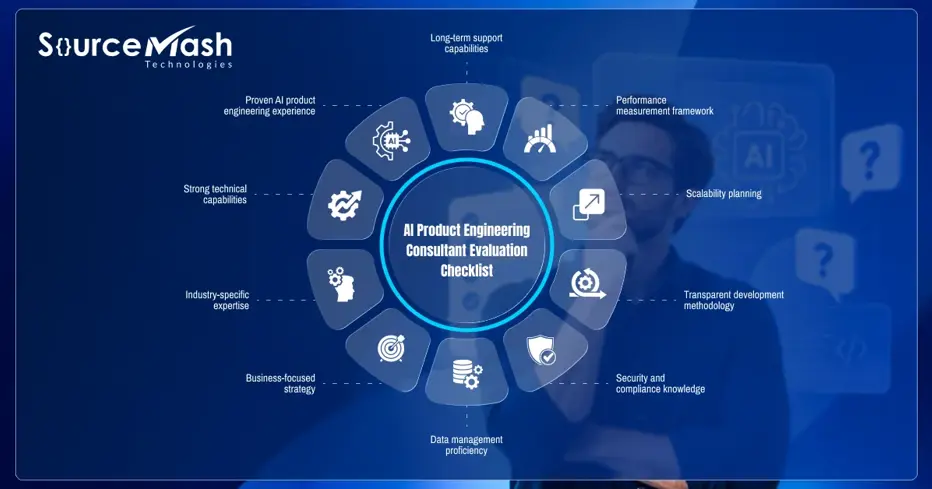
Before making your final decision, ensure the consultant can demonstrate:
✅ Proven AI product engineering experience
✅ Strong technical capabilities
✅ Industry-specific expertise
✅ Business-focused strategy
✅ Data management proficiency
✅ Security and compliance knowledge
✅ Transparent development methodology
✅ Scalability planning
✅ Performance measurement framework
✅ Long-term support capabilities
Frequently Asked Questions About Hiring an AI Product Engineering Consultant
How Do I Choose the Best AI Product Engineering Consultant?
Look for proven project success, relevant industry experience, technical expertise, strong communication skills, and a focus on measurable business outcomes.
What Industries Benefit from AI Product Engineering Consulting Services?
Healthcare, finance, manufacturing, retail, logistics, telecommunications, education, SaaS, and eCommerce organizations can all benefit from AI-powered products and services.
How Much Does It Cost to Hire an AI Product Engineering Consultant?
Costs vary depending on project complexity, technology requirements, engagement model, timeline, and customization needs.
How Long Does an AI Product Development Project Take?
Project timelines range from a few weeks for proof-of-concept implementations to several months for enterprise-scale AI product development.
Why Is Data Quality Important in AI Projects?
Data quality directly impacts model accuracy, reliability, user trust, and overall business outcomes.
Can AI Solutions Integrate with Existing Business Systems?
Yes. Experienced consultants can integrate AI solutions with existing CRM, ERP, cloud, and enterprise software environments.
Why Choose Sourcemash for AI Product Engineering Consulting?
At Sourcemash, we help businesses transform innovative ideas into scalable, intelligent, and market-ready AI products. Our team combines AI expertise, product engineering excellence, cloud-native development, and industry knowledge to build solutions that deliver measurable business results.
Whether you're launching a new AI-powered application, modernizing an existing platform, or exploring generative AI opportunities, we help you move from concept to deployment with confidence.
Our AI Product Engineering Capabilities
AI Strategy & Consulting
Helping businesses identify high-value AI opportunities and define implementation roadmaps.
Generative AI Development
Building intelligent solutions powered by modern large language models and generative AI technologies.
Machine Learning Solutions
Designing predictive and data-driven systems that support smarter decision-making.
AI Application Engineering
Developing robust AI-powered applications tailored to business requirements.
Cloud-Native Product Development
Creating scalable platforms using modern cloud technologies and architectures.
MLOps & Model Deployment
Streamlining model deployment, monitoring, and lifecycle management.
Enterprise AI Integration
Connecting AI solutions with existing business systems and workflows.
Ongoing Optimization & Support
Providing continuous improvement, maintenance, monitoring, and performance optimization services.
Conclusion
Hiring an AI Product Engineering Consultant is more than a technology decision. It is a strategic investment that can influence innovation, growth, operational efficiency, and long-term competitiveness.
By asking these ten essential questions, organizations can assess technical expertise, evaluate implementation capabilities, identify potential risks, and select a partner capable of delivering measurable business value. From data quality and security to scalability and ongoing support, every factor contributes to the success of an AI initiative.
The right AI Product Engineering Consultant will not simply build AI solutions. They will become a trusted innovation partner who helps your organization transform ideas into secure, scalable, and high-performing AI products that drive sustainable business growth and lasting competitive advantage.