The web development industry is evolving rapidly as businesses strive to deliver faster, smarter, and more engaging digital experiences. Modern users expect websites and applications to be fast, secure, personalized, accessible, and available across every device they use.
As we move into 2027, technologies such as Artificial Intelligence (AI), cloud-native infrastructure, headless architecture, real-time applications, and immersive experiences are reshaping the way digital products are built and maintained. For businesses, these innovations create opportunities to improve customer experiences, streamline operations, and stay competitive. For developers, they define the skills and technologies that will be in highest demand over the coming years.
In this article, we'll explore the top web development trends expected to influence the industry in 2027, why they matter, and how businesses can prepare for what's next.
Top Web Development Trends in 2027 at a Glance
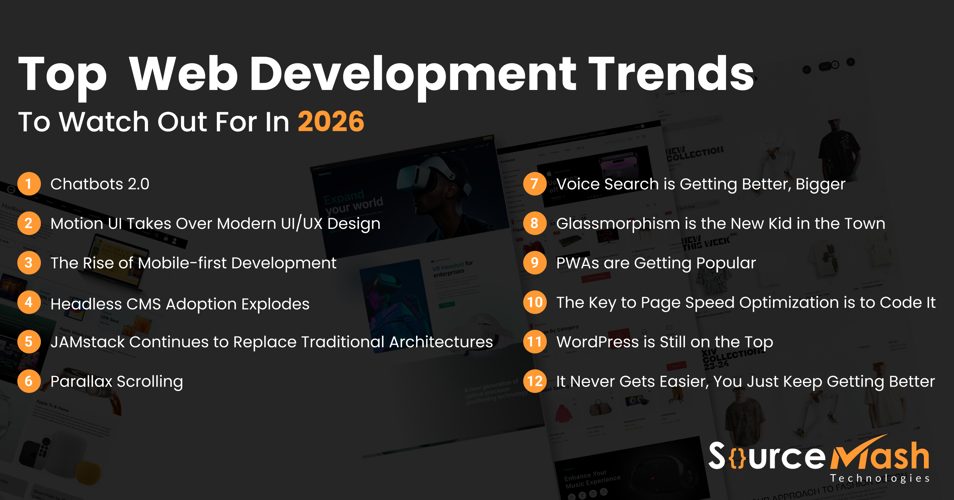
If you're looking for a quick answer, these are the web development trends expected to have the biggest impact in 2027:
- AI-Powered Development
- Progressive Web Applications (PWAs)
- Headless CMS Platforms
- Headless Architecture
- API-First Development
- Serverless Computing
- Edge Computing
- Cloud-Native Development
- Micro Frontends
- WebAssembly (Wasm)
- Cybersecurity-First Development
- Privacy-First Development
- Accessibility-First Development
- Low-Code and No-Code Development
- Voice Search Optimization
- Motion UI and Interactive Experiences
- Augmented Reality (AR) and Virtual Reality (VR)
- Internet of Things (IoT) Integration
- Sustainable Web Development
- Real-Time Web Applications
Key Takeaways
- AI is transforming how applications are developed, tested, and maintained.
- Organizations are investing in flexible architectures that support growth across multiple digital channels.
- Security, privacy, and accessibility are becoming essential business requirements.
- Cloud-native and serverless approaches are simplifying application deployment and scalability.
- Real-time functionality and immersive experiences are raising user expectations.
- Developers who embrace modern frameworks and emerging technologies will be better positioned for future opportunities.
Why Web Development Trends Matter in 2027
Technology continues to influence how customers interact with brands. A slow website, a poor mobile experience, or inadequate security can directly affect customer trust and revenue.
Modern web development trends help organizations:
- Improve customer satisfaction
- Deliver faster digital experiences
- Strengthen data security
- Increase operational efficiency
- Support future business growth
- Adapt to changing customer expectations
Understanding these trends is not about adopting every new technology. It's about identifying the innovations that can create meaningful business value.
1. AI-Powered Development
Artificial Intelligence is becoming one of the most influential forces in web development. Rather than simply powering application features, AI is increasingly helping teams design, build, test, and optimize software.
Why It Matters
Development teams are under pressure to deliver projects faster while maintaining quality. AI-powered tools help automate repetitive tasks, allowing developers to focus on solving more complex problems.
Key Applications
- AI-assisted coding
- Automated testing
- Code quality analysis
- Performance optimization
- Smart chatbots
- Content personalization
Business Impact
Organizations can accelerate development timelines, improve efficiency, and create more personalized user experiences without significantly increasing development resources.
2. Progressive Web Applications (PWAs)
Progressive Web Applications continue to bridge the gap between websites and mobile applications.
Rather than asking users to install an app, PWAs provide app-like functionality directly through a browser.
Why Businesses Are Choosing PWAs
Many organizations want to improve mobile experiences without maintaining separate iOS and Android applications.
Key Benefits
- Offline functionality
- Faster load times
- Push notifications
- Reduced development costs
- Consistent cross-device experiences
Best Use Cases
- Online stores
- Travel platforms
- Educational portals
- Media websites
PWAs remain a practical solution for businesses seeking broad accessibility and cost efficiency.
3. Headless CMS Platforms
Content must now be delivered across websites, mobile apps, smart devices, and digital displays.
Traditional CMS platforms often struggle to support this level of flexibility.
Why Headless CMS Is Growing
Headless CMS platforms separate content management from presentation layers, allowing the same content to be reused across multiple channels.
Popular Platforms
- Contentful
- Strapi
- Sanity
- Storyblok
- Hygraph
Business Benefits
- Faster content publishing
- Improved content consistency
- Easier omnichannel delivery
- Greater flexibility for development teams
4. Headless Architecture
While headless CMS focuses on content management, headless architecture applies the same principle to entire digital ecosystems.
What Makes It Different?
The frontend and backend operate independently, enabling organizations to update one without affecting the other.
Advantages
- Technology flexibility
- Faster innovation cycles
- Easier integrations
- Improved digital experiences
Headless architecture is particularly valuable for organizations managing multiple customer touchpoints.
5. API-First Development
Modern businesses rely on connected systems rather than isolated platforms.
API-first development ensures applications are designed to communicate efficiently from the beginning.
Why It's Important
Applications must integrate with payment systems, CRM platforms, analytics tools, marketing software, and other external services.
Benefits
- Simplified integrations
- Faster development
- Improved interoperability
- Future-ready infrastructure
Organizations that adopt API-first strategies can adapt more quickly to changing technology requirements.
6. Serverless Computing
Serverless computing removes the burden of managing servers and infrastructure.
Developers focus on building features while cloud providers handle scaling and maintenance.
What Makes Serverless Different?
Instead of paying for dedicated infrastructure, organizations pay only for the resources they use.
Advantages
- Cost efficiency
- Faster deployment
- Reduced operational workload
- Automatic scaling
Serverless computing enables businesses to allocate more resources toward innovation rather than infrastructure management.
7. Edge Computing
User expectations around speed continue to increase.
Even minor delays can negatively impact engagement and conversions.
Why Edge Computing Matters
By processing information closer to users, edge computing reduces delays associated with centralized data processing.
Key Benefits
- Faster response times
- Enhanced application performance
- Improved real-time functionality
- Better experiences for global audiences
Industries such as finance, gaming, and eCommerce are increasingly investing in edge-powered solutions.
8. Cloud-Native Development
Cloud-native development focuses on building applications specifically for cloud environments rather than adapting traditional systems.
Core Characteristics
- Microservices
- Containers
- Automated deployment
- Elastic scalability
Business Impact
Cloud-native applications allow organizations to respond faster to changing customer demands while improving reliability and operational resilience.
9. Micro Frontends
Large-scale applications often become difficult to maintain when multiple teams work on a single frontend codebase.
How Micro Frontends Help
This approach divides an interface into smaller independent components that can be developed and deployed separately.
Benefits
- Team autonomy
- Easier maintenance
- Faster releases
- Better scalability of large projects
Micro frontends are becoming increasingly relevant for enterprise-level applications.
10. WebAssembly (Wasm)
WebAssembly allows developers to run high-performance applications directly in a web browser.
Why It Matters
Historically, certain workloads required desktop applications because browser performance was limited.
WebAssembly is helping eliminate that gap.
Common Applications
- Video editing tools
- CAD software
- Engineering platforms
- Gaming applications
- Large data processing systems
This technology expands what developers can achieve through web-based solutions.
11. Cybersecurity-First Development
Security is no longer a final step before launch.
It is becoming an integral part of the entire development lifecycle.
Modern Security Priorities
- Zero-trust architecture
- Secure authentication
- Encrypted communication
- Threat monitoring
- Secure coding practices
Business Value
Organizations that prioritize security reduce risk, strengthen customer confidence, and improve regulatory compliance.
12. Privacy-First Development
Consumers are becoming more aware of how their personal information is collected and used.
As a result, privacy is increasingly influencing development decisions.
Key Focus Areas
- Data transparency
- User consent management
- Secure data storage
- Responsible data collection
Privacy-first development helps organizations build trust while supporting compliance requirements.
13. Accessibility-First Development
An effective digital experience should be usable by everyone.
Accessibility ensures websites and applications support people with different abilities and technology needs.
Accessibility Priorities
- Keyboard navigation
- Screen-reader compatibility
- Readable content structures
- Accessible forms
- Adequate color contrast
Why It Matters
Accessibility improves usability, expands audience reach, and creates more inclusive digital experiences.
14. Low-Code and No-Code Development
Business teams increasingly need digital solutions without lengthy development cycles.
Low-code and no-code platforms help accelerate application delivery.
Where They Deliver Value
- Internal business tools
- Workflow automation
- Departmental applications
- Rapid prototypes
Key Benefit
These platforms enable faster experimentation and innovation while reducing development bottlenecks.
15. Voice Search Optimization
The way users search online continues to evolve.
Many searches now use natural, conversational language rather than short keyword phrases.
Development Considerations
- Conversational content structures
- Question-based content
- Schema markup
- Fast-loading pages
- Mobile optimization
Organizations that optimize for voice interactions can improve accessibility and discoverability.
16. Motion UI and Interactive Experiences
Modern web experiences are becoming increasingly interactive.
Users expect interfaces to feel intuitive and responsive.
Examples
- Micro-animations
- Interactive navigation
- Visual feedback systems
- Scroll-driven storytelling
Business Benefits
Effective motion design helps guide users, improve engagement, and create more memorable experiences without overwhelming the interface.
17. AR and VR Experiences
Immersive technologies are gradually moving from experimental projects to practical business applications.
Real-World Applications
Retail
Virtual product try-ons and product visualization.
Real Estate
Interactive property walkthroughs.
Education
Immersive learning environments.
Healthcare
Training and simulation experiences.
AR and VR help users understand products, services, and environments more effectively.
18. Internet of Things (IoT) Integration
The number of connected devices continues to grow across industries.
Modern web applications are increasingly serving as control centers for connected systems.
Common Examples
- Smart home dashboards
- Industrial monitoring platforms
- Connected healthcare devices
- Fleet management systems
Why It Matters
IoT-enabled applications provide real-time visibility, automation opportunities, and operational insights.
19. Sustainable Web Development
Sustainability is becoming an important consideration in technology planning.
Organizations are looking for ways to reduce resource consumption while improving digital performance.
Sustainable Development Practices
- Efficient coding techniques
- Optimized media assets
- Lightweight frameworks
- Reduced server requests
Benefits
- Faster websites
- Lower hosting costs
- Improved efficiency
- Reduced environmental impact
Sustainable development is increasingly viewed as both a business and environmental responsibility.
20. Real-Time Web Applications
Users increasingly expect live updates and immediate interactions.
Real-time functionality is becoming standard across many industries.
Common Examples
- Live customer support
- Collaborative workspaces
- Logistics tracking systems
- Financial dashboards
Business Impact
Real-time experiences improve responsiveness, decision-making, and customer engagement.
Which Trends Will Become Mainstream by 2027?
While all twenty trends are influencing the future of web development, a few are expected to become standard across most projects.
Likely to Become Mainstream
- AI-Powered Development
- Cybersecurity-First Development
- API-First Development
- Cloud-Native Development
- Headless Architecture
- Progressive Web Applications
High-Growth Technologies
- Edge Computing
- Micro Frontends
- WebAssembly
- IoT Integration
Emerging Innovation Areas
- AR and VR Experiences
- Advanced Voice Interfaces
- Sustainable Development Practices
Understanding these categories helps businesses prioritize investments more effectively.
Frontend Framework Trends in 2027
React
React remains a leading technology for scalable and interactive user interfaces.
Next.js
Next.js continues to gain adoption due to its focus on SEO, performance, and modern rendering capabilities.
TypeScript
TypeScript has become a standard choice for large development teams seeking maintainable codebases.
Svelte
Svelte offers a lightweight approach for developers focused on speed and efficiency.
Astro
Astro is attracting attention for content-focused websites that prioritize performance.
Technologies Developers Should Learn in 2027
To stay competitive, developers should focus on:
Frontend Skills
- React
- Next.js
- TypeScript
- Vue.js
- Svelte
Backend Skills
- Node.js
- Python
- Go
- .NET
Future-Focused Technologies
- WebAssembly
- GraphQL
- AI Development Tools
- Serverless Platforms
- Cloud-Native Technologies
- Edge Computing Services
How These Trends Impact Different Industries
eCommerce
Businesses are using AI-powered recommendations, AR product visualization, and real-time personalization to improve online shopping experiences.
Healthcare
Healthcare organizations are adopting secure patient portals, connected monitoring systems, and telehealth solutions to improve patient care and operational efficiency.
Education
Educational institutions are investing in virtual classrooms, mobile-first learning platforms, and interactive digital experiences that support remote learning.
Financial Services
Financial organizations rely on advanced security, real-time data processing, and API-driven systems to improve customer services and operational reliability.
SaaS Companies
Software providers are using cloud-native infrastructure, automation, and scalable architectures to support growth while maintaining performance.
How Businesses Can Start Adopting These Trends Today
Short-Term Priorities
- Improve website speed
- Strengthen cybersecurity
- Enhance mobile experiences
- Explore AI-powered productivity tools
Mid-Term Priorities
- Adopt API-first strategies
- Modernize application architecture
- Move toward cloud-native environments
Long-Term Priorities
- Invest in real-time capabilities
- Explore immersive experiences
- Evaluate IoT opportunities
- Expand edge computing adoption
A phased approach allows organizations to balance innovation with practical business objectives.
Why Businesses Partner with Sourcemash Technologies
As web development continues to evolve, businesses need more than just access to new technologies. They need the expertise to implement them effectively and align them with their long-term goals. From AI-powered applications and cloud-native development to headless architecture, Progressive Web Apps (PWAs), and real-time web experiences, adopting the right technologies can significantly impact performance, scalability, and user engagement.
Sourcemash Technologies helps businesses navigate this evolving digital landscape by building modern, scalable, and secure web solutions tailored to their unique requirements. With a focus on innovation, performance, and user experience, the company enables organizations to leverage emerging web development trends to drive growth, improve operational efficiency, and stay competitive in a rapidly changing market.
Whether you're upgrading an existing platform or developing a new digital product, Sourcemash Technologies can help transform emerging technologies into practical solutions that deliver measurable business results.
Conclusion
The future of web development is not about adopting every emerging technology. It is about choosing the technologies that solve real business challenges, improve user experiences, and support long-term growth.
As we move into 2027, AI-powered development, cybersecurity-first practices, cloud-native infrastructure, headless architecture, API-first ecosystems, and real-time capabilities are expected to shape the next generation of digital experiences. At the same time, accessibility, privacy, and sustainability are becoming essential requirements for modern web applications.
Businesses that invest in these areas today will be better prepared for tomorrow's digital demands. Likewise, developers who continue learning modern frameworks, architectures, and emerging technologies will be well-positioned for future opportunities.
The organizations that focus on performance, security, scalability, and user value will be the ones that lead the future of the web.
FAQs
What is the biggest web development trend in 2027?
AI-powered development is expected to be one of the most influential trends because it helps streamline development processes, improve productivity, and enhance user experiences.
Are Progressive Web Apps still relevant in 2027?
Yes. PWAs continue to provide cost-effective, app-like experiences while supporting fast performance and broad accessibility.
Why is headless architecture growing in popularity?
Headless architecture gives organizations greater flexibility, supports omnichannel experiences, and enables faster innovation across digital platforms.
Which frontend technologies should developers learn in 2027?
React, Next.js, TypeScript, Svelte, and Astro are expected to remain important technologies for modern web development.
How does edge computing improve user experience?
Edge computing reduces latency by processing data closer to users, resulting in faster response times and better real-time interactions.
Which trends should businesses prioritize first?
Most organizations should focus on AI-powered development, cybersecurity, cloud-native infrastructure, API-first development, headless architecture, and Progressive Web Applications because these technologies offer immediate and long-term business value.